

Can Construction Deliveries Reach Your Rural Building Site?
Prepare a carrier and contractor discussion about getting materials onto rural property.
- 2 min read
- 4 clear steps
- Printable checklist
- Free PDF
By RealtyListingCo · Published October 25, 2026 · Reviewed October 25, 2026
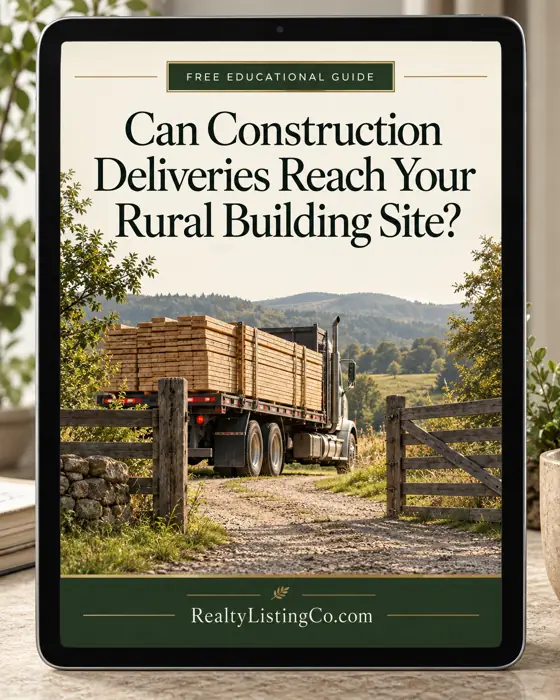
Prepare a carrier and contractor discussion about getting materials onto rural property.
- Start With the Delivery RequirementsAsk the supplier or carrier what vehicle, load and unloading information it needs.
- Collect Safe ObservationsFrom authorized, safe locations, note gates, sharp turns, overhead obstacles and visible surface conditions.
- Assign the Approval QuestionsSeparate permission to use the route from whether the route can support the proposed delivery.
- Agree on a Contingency Before BookingAsk about weather delays, rejected access, waiting charges and alternative unloading arrangements.
Can Construction Deliveries Reach Your Rural Building Site?
You have a materials quote and a delivery date, but nobody has confirmed how a loaded vehicle will reach the unloading area. A driveway that works for a car may raise different questions for a carrier. Resolving those questions early helps keep a logistics problem from becoming a surprise on delivery day.
§ 1 Step 1 of 4 Start With the Delivery Requirements
Ask the supplier or carrier what vehicle, load and unloading information it needs. Confirm whether the quoted service ends at the road, includes travel onto the parcel or includes unloading. Keep the exact answer with the quote. Avoid assuming that delivery to an address means delivery to the future building site.
§ 2 Step 2 of 4 Collect Safe Observations
From authorized, safe locations, note gates, sharp turns, overhead obstacles and visible surface conditions. Use labeled photographs to help a qualified reviewer understand the route. Do not guess bridge capacity, test unstable ground or enter someone else’s land. Treat any dimension you have not reliably measured as an open question.
§ 3 Step 3 of 4 Assign the Approval Questions
Separate permission to use the route from whether the route can support the proposed delivery. Ask the carrier, contractor and appropriate local professionals who must review each issue. Ask a legal adviser about unclear access documents. An existing access right should not be assumed to authorize every proposed vehicle or activity.
§ 4 Step 4 of 4 Agree on a Contingency Before Booking
Ask about weather delays, rejected access, waiting charges and alternative unloading arrangements. Name who will be present and how the driver will contact them. Record who can approve a change in scope or price. Do not improvise a new route, lift or unloading method when a carrier identifies a safety concern.
A Practical Example
A lumber quote excludes unloading. The buyer records the missing unloading plan and asks the carrier and contractor who will supply equipment before confirming a date.
Illustrative example, not a case history or a recommended legal outcome.
When to get help
This is not an engineering assessment, route approval or permission to cross another property. Do not measure unsafe road areas or test bridge capacity yourself.
Your Next Steps
One thing to do today: Collect available route photos and existing access documents from safe, authorized locations.
Ticks stay on this page while you read. Print to keep a copy.
One thing to do today: Collect available route photos and existing access documents from safe, authorized locations.
Appendix B · Sources & further reading
- NAIC — Title Insurance and Public Record Searches. . content.naic.org
- FTC — How to Avoid a Home Improvement Scam. . consumer.ftc.gov
Sources last reviewed October 25, 2026
Your next step depends on your situation
Keep this guide for when you need it
Download a printable copy to keep with your papers or share with family. No purchase required, and you can keep reading without giving an email.
- All 4 steps in a printable layout
- The first-step checklist
- Sources and the professional-advice disclaimer
Raw Land True Cost Calculator
Explore an illustrative estimate alongside the questions in this guide.
More Land & Acreage guides All Land & Acreage guides →
Before You Buy Land, Start With These Five Checks
Read the guide →A Road to the Parcel Is Not the Whole Access Answer
Organize the records and questions that help a title professional, attorney and surveyor review access to a parcel.
Read the guide →Buying Land With Unanswered Well and Septic Questions
Separate available records, site evaluations and approvals so early information is not mistaken for a final answer.
Read the guide →The Land Price Is Only One Part of the Budget
Bring separate provider estimates into one planning record without treating unknown costs as zero or assuming financing is available.
Read the guide →Can You Use the Land the Way You Want?
Turn a vague plan for a parcel into specific zoning and restriction questions before committing to a purchase.
Read the guide →A Dry Site Visit Does Not Answer Every Flood-Risk Question
Use flood information to prepare local questions before relying on a parcel’s appearance or a listing description.
Read the guide →Will Reliable Internet Reach Your Rural Property?
Compare what providers can actually install at a particular parcel before relying on an advertised coverage area.
Read the guide →Put the guide into practice Explore Land & Acreage resources →
 Land Zoning Access and Easement Questions Workbook See current formats View details →
 Land and Acreage Buyer Due Diligence Workbook See current formats View details →
 Rural Well Septic and Utility Review Workbook See current formats View details →
 Land Financing and Site Cost Questions Workbook See current formats View details →
A note on professional advice. This guide is general education, not legal, financial or tax advice. Requirements vary by jurisdiction, documents and individual circumstances. Consult appropriately qualified local professionals before consequential decisions or signatures. Observations, maps and planning lists do not verify legal access, boundaries, water rights, wastewater suitability, zoning, permits or buildability. This is not engineering, environmental, electrical or construction advice. Consult relevant local authorities and qualified legal and technical professionals before buying, signing, disturbing land or beginning work. Read our full Educational Disclaimer.
The Reading Room · RealtyListingCo · Free educational guides