

A Road to the Parcel Is Not the Whole Access Answer
Organize the records and questions that help a title professional, attorney and surveyor review access to a parcel.
- 2 min read
- 4 clear steps
- Printable checklist
- Free PDF
By RealtyListingCo · Published October 7, 2026 · Reviewed October 7, 2026
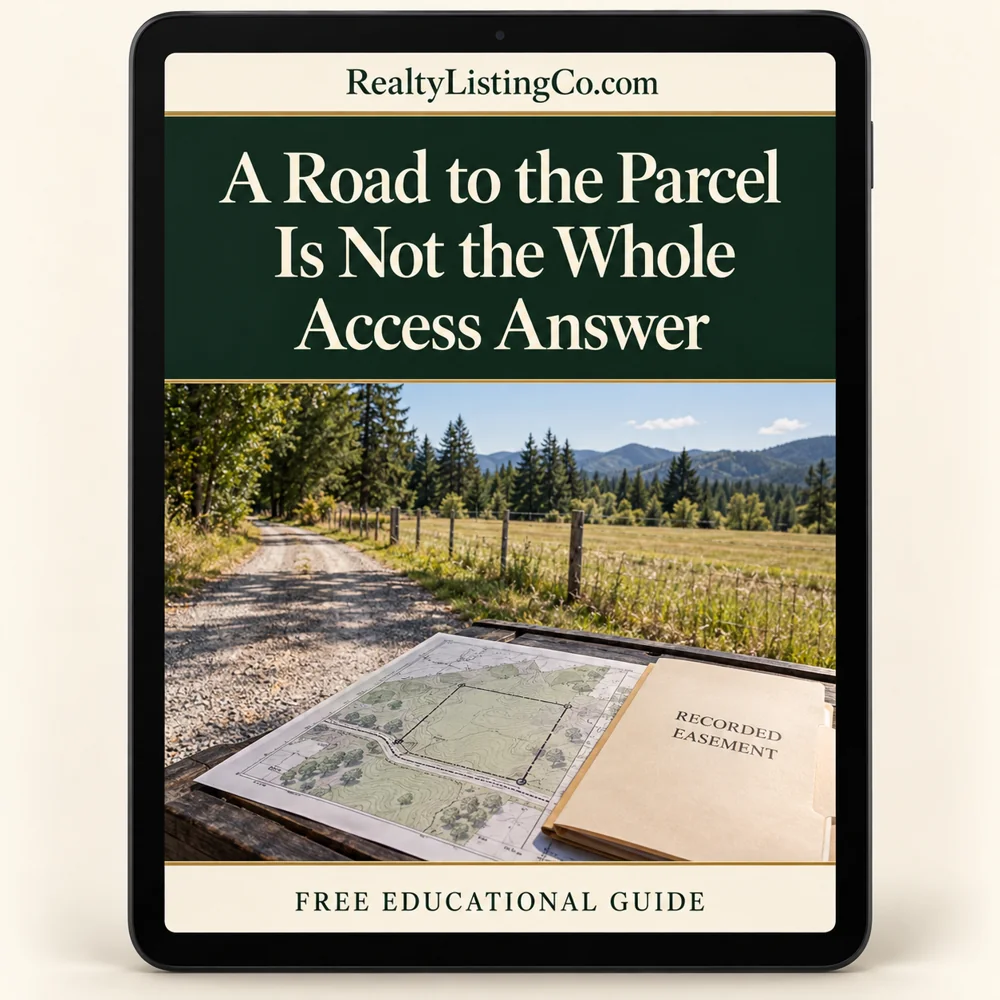
Create an access question log supported by documents, with unresolved items clearly assigned to a qualified professional.
- Start With the Exact Parcel and Intended UseRecord the parcel identifier, jurisdiction and how you expect to use the land.
- Request Records for Professional ReviewAsk a title professional or local real estate attorney which recorded documents describe access rights, easements and restrictions.
- Keep Rights and Maintenance Questions SeparateUse two headings in your notes: permission to use the route, and responsibility for maintaining it.
- Give Unknowns a Next StepFor each open item, name who is investigating, the record needed and the actual date by which your transaction requires an answer.
Unclear Access and Boundaries
You can drive to the property, the listing says road access, and a neighbor says the track has always been used. Those observations leave important questions unanswered: what rights exist, where they apply and whether they support your plans. Discovering the uncertainty late can disrupt both your timeline and your budget.
§ 1 Step 1 of 4Start With the Exact Parcel and Intended Use
Record the parcel identifier, jurisdiction and how you expect to use the land. Separate everyday vehicle access from questions about construction vehicles, emergency access and utility installation. Ask the local planning or road office which physical access standards apply to that proposed use. An answer about one type of access may leave another question open.
§ 2 Step 2 of 4Request Records for Professional Review
Ask a title professional or local real estate attorney which recorded documents describe access rights, easements and restrictions. Ask a licensed surveyor what information is needed to locate relevant boundaries and access features. Penn State Extension identifies title restrictions and access easements as important farmland-purchase questions. Do not interpret a deed description or an old map as a legal conclusion yourself.
§ 3 Step 3 of 4Keep Rights and Maintenance Questions Separate
Use two headings in your notes: permission to use the route, and responsibility for maintaining it. Record questions about gates, seasonal conditions, repairs, snow removal where relevant and any written maintenance arrangement. Keep the document reference beside each answer. If someone offers a verbal assurance, record it as unverified until the appropriate professional confirms what can be relied on.
§ 4 Step 4 of 4Give Unknowns a Next Step
For each open item, name who is investigating, the record needed and the actual date by which your transaction requires an answer. Ask your attorney or transaction professional about the implications of missing that date. Do not assume you can extend a deadline, cross another property or obtain an easement after purchase.
A Practical Example
A buyer has photographs of a gravel track but no document explaining access. Their log records the track as a physical observation, not a confirmed right. The next task is a title review, followed by a surveyor’s assessment of location and a separate question about maintenance responsibilities.
Illustrative example, not a case history or a recommended legal outcome.
When to get help
Get qualified local legal advice if access is disputed, the route crosses another property or a document is unclear. A site visit, neighbor conversation or checklist cannot establish an easement or resolve a boundary dispute.
Your Access Review Notes
One thing to do today: Write down the access claim you are relying on and the document or professional answer needed to verify it.
Ticks stay on this page while you read. Print to keep a copy.
One thing to do today: Write down the access claim you are relying on and the document or professional answer needed to verify it.
Appendix B · Sources & further reading
- Penn State Extension — Owning and Leasing Agricultural Real Estate. . extension.psu.edu
Sources last reviewed October 7, 2026
Your next step depends on your situation
Keep this guide for when you need it
Download a printable copy to keep with your papers or share with family. No purchase required, and you can keep reading without giving an email.
- All 4 steps in a printable layout
- The first-step checklist
- Sources and the professional-advice disclaimer
Raw Land True Cost Calculator
Explore an illustrative estimate alongside the questions in this guide.
More Land & Acreage guides All Land & Acreage guides →
Before You Buy Land, Start With These Five Checks
Read the guide →Buying Land With Unanswered Well and Septic Questions
Separate available records, site evaluations and approvals so early information is not mistaken for a final answer.
Read the guide →The Land Price Is Only One Part of the Budget
Bring separate provider estimates into one planning record without treating unknown costs as zero or assuming financing is available.
Read the guide →Can You Use the Land the Way You Want?
Turn a vague plan for a parcel into specific zoning and restriction questions before committing to a purchase.
Read the guide →A Dry Site Visit Does Not Answer Every Flood-Risk Question
Use flood information to prepare local questions before relying on a parcel’s appearance or a listing description.
Read the guide →Will Reliable Internet Reach Your Rural Property?
Compare what providers can actually install at a particular parcel before relying on an advertised coverage area.
Read the guide →Put the guide into practice Explore Land & Acreage resources →
 Land Zoning Access and Easement Questions WorkbookSee current formatsView details →
 Land and Acreage Buyer Due Diligence WorkbookSee current formatsView details →
 Rural Well Septic and Utility Review WorkbookSee current formatsView details →
 Land Financing and Site Cost Questions WorkbookSee current formatsView details →
A note on professional advice. Real estate laws, property ownership and title requirements, and tax implications vary significantly by state, county and municipality. These educational materials provide a general framework for discussion and preparation only; they do not constitute legal, financial or tax advice. Before signing agreements, transferring property or making decisions with legal, financial or tax consequences, consult appropriately qualified professionals in the jurisdiction where the property is located. Read our full Educational Disclaimer.
The Reading Room · RealtyListingCo · Free educational guides