

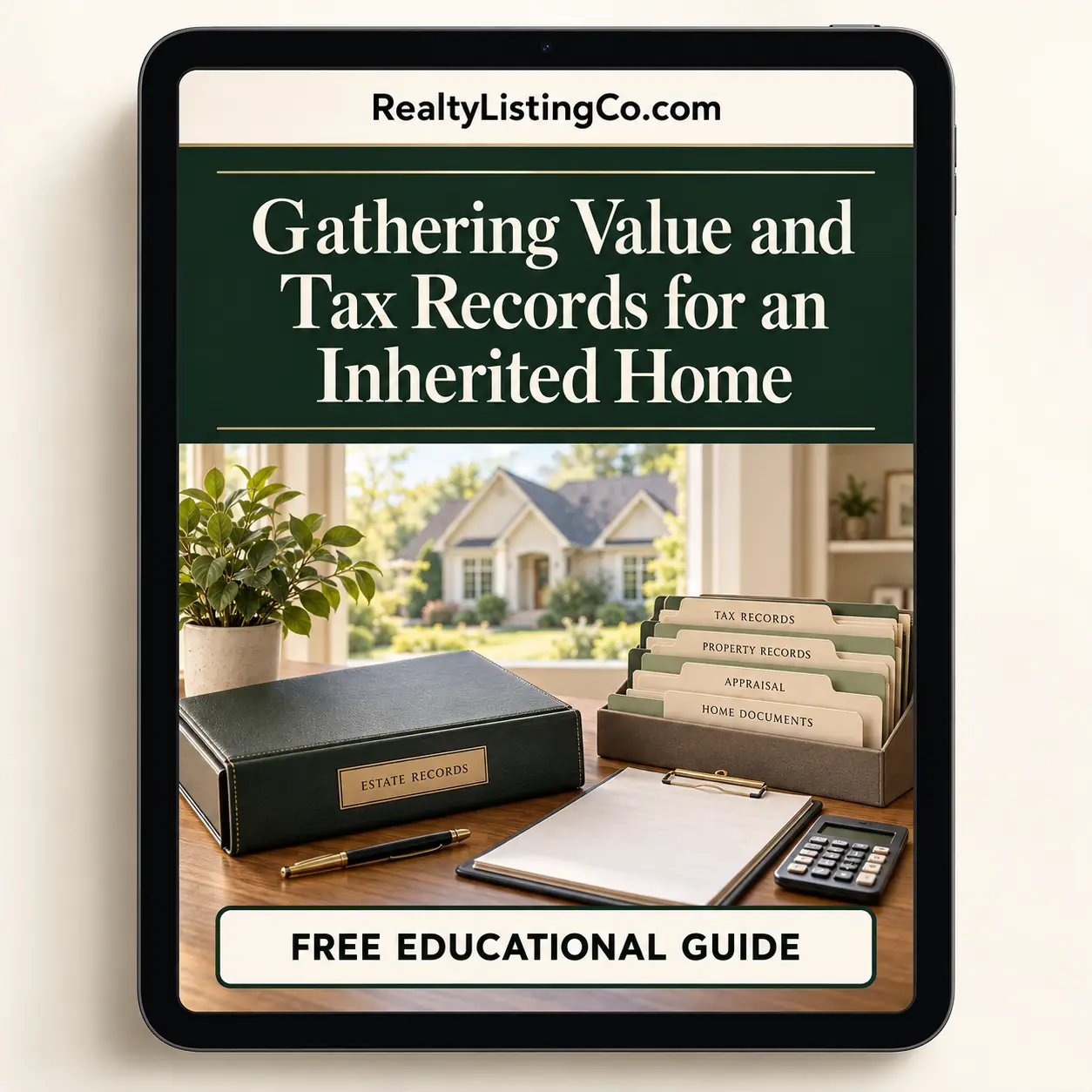
Gathering Value and Tax Records for an Inherited Home
Prepare a document packet for your estate and tax professionals without guessing the home’s tax basis.
- 2 min read
- 4 clear steps
- Printable checklist
- Free PDF
By RealtyListingCo · Published October 14, 2026 · Reviewed October 14, 2026
Organize the evidence a qualified professional needs to explain valuation, basis and reporting for your situation.
- Identify the Estate’s Point of ContactAsk who is authorized to hold and provide estate records.
- Separate Different Kinds of ValueKeep market opinions, tax assessments, appraisals and proposed sale prices in separate folders with their dates and purposes.
- Ask How Basis Applies to This PropertyIRS guidance says inherited-property basis is generally connected to date-of-death fair market value, with exceptions and other rules that can apply.
- Preserve the Supporting PaperworkGather existing appraisal reports, estate tax information supplied to you, improvement records and eventual sale closing documents.
Missing Records and Conflicting Values
One relative quotes an online estimate, another remembers the purchase price, and a third assumes the entire sale proceeds will be tax-free. These figures answer different questions. Missing records can make a later sale discussion harder than it needs to be.
§ 1 Step 1 of 4Identify the Estate’s Point of Contact
Ask who is authorized to hold and provide estate records. Request copies through that person rather than distributing sensitive papers widely. Note the property address, ownership documents available, relevant estate contacts and dates that your adviser asks you to confirm.
§ 2 Step 2 of 4Separate Different Kinds of Value
Keep market opinions, tax assessments, appraisals and proposed sale prices in separate folders with their dates and purposes. Do not substitute one for another. Ask your estate or tax professional what valuation evidence is needed, who should prepare it and whether an earlier valuation already exists.
§ 3 Step 3 of 4Ask How Basis Applies to This Property
IRS guidance says inherited-property basis is generally connected to date-of-death fair market value, with exceptions and other rules that can apply. That general statement does not establish your basis, eliminate reporting or guarantee a tax-free sale. Ask a qualified tax professional to review the ownership and estate circumstances before using a number.
§ 4 Step 4 of 4Preserve the Supporting Paperwork
Gather existing appraisal reports, estate tax information supplied to you, improvement records and eventual sale closing documents. Ask which additional records and retention periods apply. Use a missing-items list instead of estimating figures you cannot support; label all provisional amounts clearly.
A Practical Example
An heir has a current online estimate but no earlier appraisal. Their packet labels the estimate as a current marketing reference. They ask the estate representative and tax adviser what valuation records are needed for the tax question.
Illustrative example, not a case history or a recommended legal outcome.
When to get help
Consult a qualified estate attorney and tax professional before distributions, transfers or tax filings. Joint ownership, trusts, prior gifts, rental use and estate filings can create issues a general checklist cannot resolve.
Your Inherited-Home Records Packet
One thing to do today: Create separate folders for ownership, valuation, expenses and tax correspondence.
Ticks stay on this page while you read. Print to keep a copy.
One thing to do today: Create separate folders for ownership, valuation, expenses and tax correspondence.
Appendix B · Sources & further reading
- IRS — Gifts and Inheritances. . www.irs.gov
Sources last reviewed October 14, 2026
Your next step depends on your situation
Keep this guide for when you need it
Download a printable copy to keep with your papers or share with family. No purchase required, and you can keep reading without giving an email.
- All 4 steps in a printable layout
- The first-step checklist
- Sources and the professional-advice disclaimer
Inherited Home: Keep, Rent or Sell Calculator
Explore an illustrative estimate alongside the questions in this guide.
More Inherited Homes guides All Inherited Homes guides →
What to Organize First After Inheriting a Home
Read the guide →Who Can Act for an Inherited Home Before Decisions Are Made?
Prepare the document and contact record needed to clarify authority, protect information and raise urgent property questions.
Read the guide →Who Handles the Mortgage and Bills While Heirs Decide?
Gather mortgage information and keep a factual payment record without assuming who owes a debt or who must be repaid.
Read the guide →When Heirs Disagree About Selling, Keeping or Renting the Home
Prepare an options discussion that separates family preferences, missing information and the decisions requiring professional advice.
Read the guide →Before Listing an Inherited Home, Organize the Document Gaps
Build a document request list so the estate, title and transaction professionals can identify unresolved issues early.
Read the guide →Put the guide into practice Explore Inherited Homes resources →
A note on professional advice. Real estate probate laws, title vesting (how ownership is held) and tax implications vary significantly by state, county and municipality. These educational materials provide a general framework for discussion and preparation only; they do not constitute legal, financial or tax advice. Before signing any agreements or transferring property titles, co-heirs and estate representatives must consult a licensed probate attorney, a qualified estate-planning professional or a Certified Public Accountant (CPA) with relevant expertise in the property’s jurisdiction, as appropriate to the issue. These materials do not establish ownership or authority to act for an estate. Read our full Educational Disclaimer.
The Reading Room · RealtyListingCo · Free educational guides